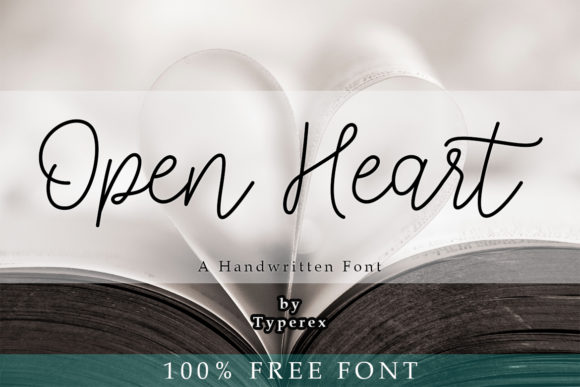
Open Heart Font: A Handwritten Display Typeface for Elegant Digital Branding
As a UI designer who ships landing pages, SaaS dashboards, and boutique e-commerce sites, I reach for Open Heart when I need a handwritten font that feels intentional—not whimsical, not cutesy, but warmly human and quietly confident. Open Heart is a freebie font with the polish of a premium script typeface: soft entry and exit strokes, balanced letter spacing, and subtle contrast that holds up beautifully on screen. It’s not built for long paragraphs—but it excels where digital design needs emotional resonance: hero headlines, brand taglines, CTA overlays, and signature moments in a scroll-driven experience.
Open Heart for Wedding Invitations and Elegant Branding
Even though Open Heart is listed under Freebies, its application in high-intent digital contexts—like wedding planner websites or luxury invitation suites—proves it’s far from disposable. When used as a display font over a clean sans serif (think Inter, Poppins, or Manrope), Open Heart instantly signals sophistication and care. On a responsive wedding portfolio site, I use it for the headline “Your Story, Thoughtfully Designed” — sized at 48px on desktop, 32px on mobile — with letter-spacing tightened to 0.5px to preserve legibility without sacrificing flow. Because Open Heart is a lightweight script, it avoids visual fatigue in short bursts—even against soft gradient backgrounds or delicate floral overlays.
Open Heart for Thank You Cards and Post-Purchase UX
In e-commerce and SaaS flows, the “thank you” moment is a conversion touchpoint—not just a page. That’s where Open Heart shines as a fonts asset for branded microcopy. I’ve embedded Open Heart into post-checkout modals for handmade goods stores and digital course platforms, pairing it with a neutral body font to highlight phrases like “Thank you for trusting us” or “Your download is ready.” Because Open Heart is a true handwritten font—not a calligraphic simulation—it adds authenticity without looking staged. For accessibility, I keep it limited to 24–36px range on light backgrounds and avoid using it on dark mode unless testing contrast ratios manually (its thin strokes drop below WCAG AA at small sizes).
Open Heart for Quotes and Social Media Graphics
When designing quote cards for Instagram carousels or blog social previews, Open Heart delivers immediate tonal clarity. Its elegance reads as thoughtful, not stiff—perfect for coaches, writers, and wellness brands who want warmth without informality. As a web designer, I convert Open Heart to SVG text for static banners (to avoid FOUT) and serve it via @font-face for dynamic CMS-generated quote blocks. One caveat: Open Heart includes only one weight and no italics, so it works best as a standalone display font—not as part of a complex typographic system. Use it for the quote itself, then switch to a highly legible sans serif for attribution.
Open Heart for Greeting Cards and Email Campaign Headers
Email remains one of the highest-ROI channels for creative entrepreneurs—and typography is the first impression before the subject line even loads. Open Heart performs surprisingly well in email clients when embedded as a web-safe fallback stack (e.g., font-family: 'Open Heart', 'Brush Script MT', cursive;). I use it sparingly: only in tags inside hero sections of seasonal campaigns (“Happy Holidays, From Our Heart to Yours”). Because Open Heart is a free fonts resource, it lowers the barrier for solopreneurs building their own email templates—no licensing friction, no variable font bloat. Just clean, heartfelt presence.
Open Heart for Logos and Business Cards in Web-First Brands
Logos live across devices—and Open Heart scales gracefully when used in monoline, single-color contexts. I’ve implemented it as the wordmark for a ceramic studio’s website header and as the embossed foil accent on their digital business card PDF (exported from Figma with vector outlines). Since Open Heart lacks alternate glyphs or ligatures, it’s predictable and production-ready—no surprise kerning shifts between mockup and live site. For web use, I convert the logo to SVG and pair it with a crisp sans serif for navigation labels. This creates clear visual hierarchy: Open Heart says “this is who we are,” while the supporting type says “here’s how to engage.”
Open Heart for Handwritten Design Elements Across Digital Products
Every design system needs texture—and Open Heart is my go-to for subtle handwritten accents: section dividers (“Our Process”), testimonial pull-outs, pricing plan highlights (“Most Popular”), or even animated hover states on CTA buttons. Because it’s a freebie font, I can embed it confidently in client-facing Figma kits and Notion brand guidelines without license overhead. But here’s what matters most: Open Heart never competes with usability. It supports intent—not obscures it. Used at 20–28px over ample whitespace, it guides the eye without demanding attention. That balance is rare in script fonts—and essential for conversion-focused layouts.
Font Pairing Tips for Open Heart in Web Design
- For editorial sites: Pair Open Heart with a warm serif like Lora or Playfair Display for headings + body rhythm.
- For SaaS dashboards: Use Open Heart only in empty-state illustrations or onboarding modals—never in data tables or form labels.
- For online stores: Apply Open Heart to product collection headers (“Handcrafted With Love”) and pair with a neutral sans like Space Grotesk for price tags and CTAs.
- Always test: Preview Open Heart on iOS Safari and Android Chrome—some handwritten fonts render inconsistently on older WebView engines.
Open Heart isn’t just another free fonts download—it’s a deliberate tool for designers who understand that tone lives in type. Whether you’re launching a wedding brand, refining a creator’s online store, or adding soul to a SaaS onboarding flow, this handwritten font delivers elegance without excess. And because it’s a freebie, there’s zero risk in testing it in your next Figma prototype or live landing page. Just remember: Open Heart earns its place by doing one thing exceptionally well—making digital experiences feel human.