Storyteller Font: A Natural Handwritten Typeface for Makers
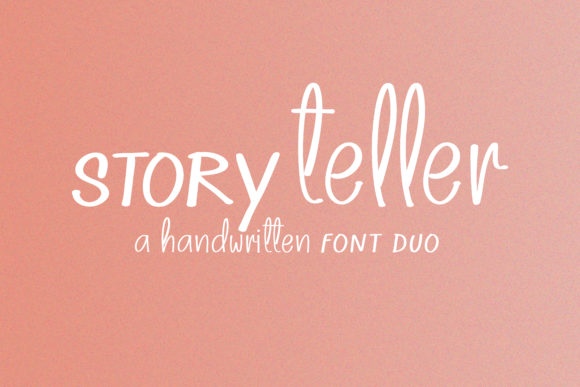
There’s that quiet moment—just before printing—when you’re previewing a candle label in your design software and the font feels *off*. Too stiff. Too generic. Too… not *yours*. That’s when I reached for Storyteller. Instantly, the warmth returned—not just to the layout, but to the whole feeling of the product. Because Storyteller is a great handwritten font. Its natural and unique style makes it incredibly fitting to a large pool of designs. The only limit is your imagination—and honestly? That’s exactly how it feels when you start layering it onto real handmade goods.
Storyteller for Candle Labels and Small-Batch Packaging
As a maker who hand-pours soy candles with botanical names like “Lavender & Rain” or “Sage & Smoke,” authenticity matters—on the jar, on the tag, even in the listing thumbnail. Storyteller, as a Script Handwritten font, brings gentle irregularity: slight variations in stroke weight, subtle entry/exit flourishes, and organic spacing that mimics real pen-on-paper rhythm. It reads as human—not algorithmic. For candle labels printed at 12–16pt on kraft sticker paper, I use the regular weight only (no thin variants), and always test cut first on my Cricut Maker. The curves hold beautifully at that size—no jagged edges, no lost detail. Pair it with a clean sans serif like Montserrat Light for ingredient lists or scent notes, and suddenly your packaging feels intentional, elevated, and quietly luxurious.
Storyteller for Greeting Cards and Handmade Stationery
I designed a set of birthday cards last month using Storyteller for the front sentiment (“You Make Every Day Brighter”) and kept the inside message in a simple serif. The contrast worked because Storyteller isn’t trying to be everything—it’s a display font, not body text. Its charm lives in short phrases, names, titles, and decorative wording. On 300gsm cotton cardstock, printed via home inkjet, the ink slightly blooms into the fibers—enhancing the handwritten illusion. No need for faux texture overlays. Just Storyteller, well-kerned, with generous line spacing. As a Fonts choice for physical stationery, it invites touch, slows down the reader, and makes the recipient feel seen—not sold to.
Storyteller for Wedding Invitations and Elegant Branding
When a friend asked me to help design her wedding suite—cream linen paper, pressed florals, minimalist layout—I knew right away: Storyteller for the couple’s names and date. Not for addresses or RSVP details, but for the emotional anchor. Its natural flow echoes calligraphy without requiring a dip pen or practice sheet. And because Storyteller is a great handwritten font, it pairs effortlessly with refined serifs (think Playfair Display) or airy sans fonts (like Raleway). In PDF previews for digital proofs, it renders crisply—even on mobile screens. For physical printing, I confirmed the font includes OpenType ligatures and alternate characters (a must for avoiding awkward letter collisions like “tt” or “ff” in names). That small detail kept the invitation feeling bespoke, not templated.
Storyteller for Printable Wall Art and Digital Downloads
My latest Etsy listing—a set of three printable quote posters for cozy living rooms—relies entirely on Storyteller for the central phrase (“Breathe Deeply,” “Gather Joy,” “Stay Soft”). Why? Because Storyteller carries mood as much as meaning. Its soft contrast and rhythmic slant create visual calm—perfect for wellness-themed printables. As a Script Handwritten typeface, it avoids the sterility of overused brush fonts while staying legible at 48–72pt on 8x10” prints. I embedded it in layered PNG mockups (using transparent backgrounds) so buyers could preview how it looks on framed art or gallery walls. Important note: I double-checked the license—yes, this Fonts file allows commercial use for digital downloads, including resale of edited PDFs and PNGs. No hidden restrictions. Just clean, creative freedom.
Storyteller for Boutique Tags and Seasonal Product Labels
For holiday gift tags—mini kraft cards tied to handmade soaps or ceramic mugs—I scale Storyteller down to 10–11pt. It remains readable *if* you avoid tight tracking and skip the lightest weight. The key is testing: print one tag, hold it at arm’s length, squint slightly. Does the word still read? With Storyteller, yes—because its letterforms are distinct, not overly connected. Unlike some script fonts that blur into cursive tangles, Storyteller keeps clarity in short bursts. I’ve used it for “Merry & Bright,” “Hand-Poured with Love,” and “From Our Home to Yours”—phrases that land emotionally *because* the typography feels personal. That’s the quiet power of a truly natural Script Handwritten font.
Storyteller for Planner Pages and Creative Journal Inserts
In my weekly planner inserts, Storyteller headlines each section: “Today’s Intentions,” “Gratitude Log,” “Big Rocks This Week.” It doesn’t dominate—just gently guides. Since these are printed on 120gsm matte paper and hole-punched for ring binders, legibility under daily handling matters. I avoid using Storyteller for full paragraphs (it’s not built for that), but for titles and headers? Pure magic. Its uniqueness helps users visually scan pages faster—color-coded sections *and* distinct typography work together. As a Fonts choice for functional creativity, Storyteller proves that utility and beauty aren’t opposites—they’re collaborators.
Using Storyteller Across Physical and Digital Products
Whether you're cutting vinyl for tote bags, exporting SVG files for Silhouette users, designing Shopify banners, or prepping Canva templates for clients, Storyteller adapts. Its OTF and TTF files install cleanly on Mac and Windows. I’ve used it in Procreate (via font import), Adobe Illustrator (for vector cut files), and even Google Docs (for client briefs). Just remember: always convert to outlines before sending final files to printers—or embed properly in PDFs. And always verify commercial licensing covers your use case: physical products, digital templates, merch, or social media graphics. With Storyteller is a great handwritten font, its natural and unique style makes it incredibly fitting to a large pool of designs. The only limit is your imagination—and honestly? That’s where the best making begins.